| Version 5 (modified by , 8 weeks ago) ( diff ) |
|---|
Parallel Computing
Moore's law
.png)
- 2X transistors/Chip Every 1.5 years Called “Moore’s Law”
- Microprocessors have become smaller, denser, and more powerful.
-- Gordon Moore (co-founder of Intel) predicted in 1965 that the transistor density of semiconductor chips would double roughly every 18 months. --
Multi-tasks
- In computing, multitasking is a method where multiple tasks, also known as processes, are performed during the same period of time.
- The tasks share common processing resources, such as a CPU and main memory.
- In the case of a computer with a single CPU, only one task runs at any point in time.
- Multitasking solves the problem by scheduling which task may run at any given time, and when another waiting task gets a turn.
- When task switches occur frequently enough the illusion of parallelism is achieved.
End of clock speed scaling
CPU clock speed, or clock rate, is measured in Hertz — generally in gigahertz, or GHz. A CPU’s clock speed rate is a measure of how many clock cycles a CPU can perform per second. For example, a CPU with a clock rate of 1.8 GHz can perform 1,800,000,000 clock cycles per second.
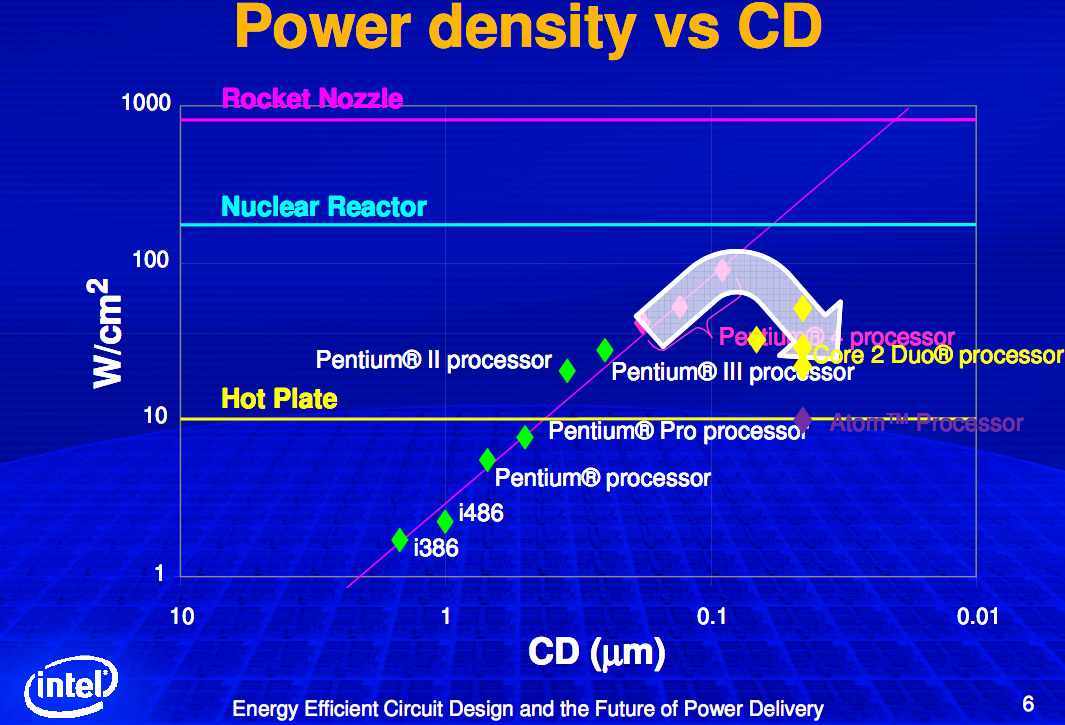
- Clock speed is the biggest contributor to power.
- Intel pushed clock speeds very hard in the 90s and early 2000s.
- Doubling the clock speed increased power by 2-8x....
- More power generates more heat... Heat is becoming an unmanageable problem.....
Multi-core
After Core2 Duo, Intel's CPUs have multiple cores.
Modern computers have multi-core CPUs.

A multi-core processor is a single computing component with two or more independent actual central processing units (called "cores"), which are the units that read and execute program instructions. The multiple cores can run multiple instructions at the same time, increasing overall speed for programs amenable to parallel computing.
Developing Codes for Multi-Cores
- Computer programs developed for old CPUs run on a single core.
- Simple C/C++ and Fortran code runs on just one core.
- We have to develop codes that use multiple cores.
Co-Processors / Accelerator
A coprocessor / Accelerator is a computer processor used to supplement the functions of the primary processor (the CPU). Operations performed by the coprocessor may be floating-point arithmetic, graphics, signal processing, string processing, encryption or I/O Interfacing with peripheral devices. By offloading processor-intensive tasks from the main processor, coprocessors can accelerate system performance.
GPU
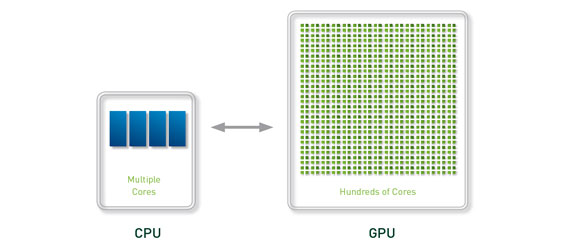
A graphics processing unit (GPU), also occasionally called a visual processing unit (VPU), is a specialized electronic circuit designed to rapidly manipulate and alter memory to accelerate the creation of images in a frame buffer intended for output to a display. GPUs are used in embedded systems, mobile phones, personal computers, workstations, and game consoles. Modern GPUs are very efficient at manipulating computer graphics, and their highly parallel structure makes them more effective than general-purpose CPUs for algorithms where processing of large blocks of data is done in parallel. In a personal computer, a GPU can be present on a video card, or it can be on the motherboard.

GPU computing
GPU-accelerated computing is the use of a graphics processing unit (GPU) together with a CPU to accelerate scientific, engineering, and enterprise applications.
Intel Xeon Phi
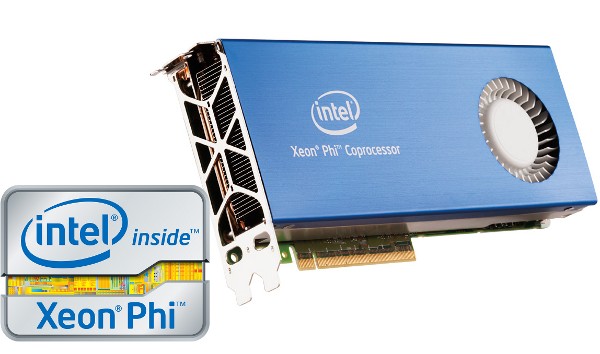
Intel Many Integrated Core Architecture or Intel MIC is a coprocessor computer architecture developed by Intel, the Teraflops Research Chip multicore chip research project, and the Intel Single-chip Cloud Computer multicore microprocessor.

Speedup Factor

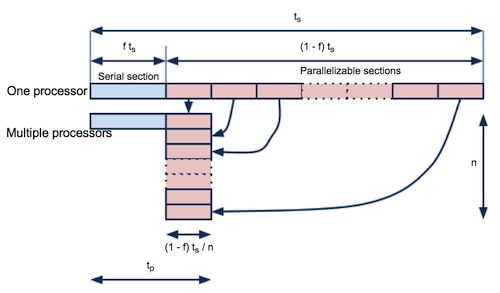
- Suppose you have a code that takes Ts seconds to run on one processor.
- You find there are parallelizable sections in the code. But for the other sections, it still needs to run on a single processor. (For OpenMP)
- For MPI codes, the processes run in parallel from the beginning, but there must be some parts where all processes do same things.
- Those parts are considered as serial sections.
- The time ratio of the serial section to the total is F, so time for the serial section is F Ts and the parallelizable section is (1-f) Ts.
- If you use N processors, the time for the parallelizable section can be reduced to (1-f) Ts/N.
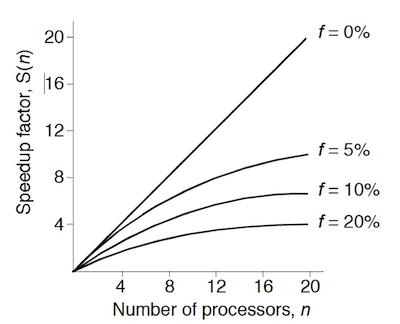
- Here the Speedup factor is defined as
S(N)=(computing time on a single processor)/(computing time on multiple processors) = Ts/[F Ts+(1-f)Ts/N] = N/(1+(N-1)F)
This is the Amdahl's Law.

Overhead time
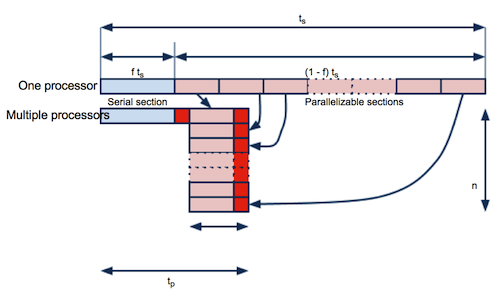
- Since some extra procedures are required for parallelization, there are overheads of each parallel process.
- For MPI codes, the communication between processes is a major overhead.
- We can reduce this negative impact by overlapping communication with computations.
- For OpenMP, there are overhead time at the fork and join threads.

Attachments (7)
- 6-18-201intelxeonphipciecard.jpg (45.9 KB ) - added by 11 years ago.
- CPUpowerDensity.png (796.0 KB ) - added by 11 years ago.
- gpu-computing-feature.jpg (25.2 KB ) - added by 11 years ago.
- Moores_law_(1970-2011).png (99.3 KB ) - added by 11 years ago.
- Speedup_fac1.png (38.8 KB ) - added by 11 years ago.
- Speedup_fac2.png (58.5 KB ) - added by 11 years ago.
- Speedup_fac3.png (36.8 KB ) - added by 11 years ago.
Download all attachments as: .zip

.png)